WeatherXM’s Beaver NFTs test a new model for DePIN funding through Targeted Rollouts
When people think of weather networks, they picture satellites or billion-dollar government systems.
But the truth is, most of the weather data you check on your phone still comes from surprisingly sparse networks. Often, developing regions are left with little to no coverage.
WeatherXM has been trying to fix that through decentralization, turning weather stations into community-powered data nodes where contributors gain tokens for maintaining reliable coverage.

Listen, weather isn’t just small talk. It’s big economics.
Nearly two-thirds of the global economy is weather-sensitive, from agriculture and logistics to insurance and energy. Yet forecasting remains imprecise, costing the world an estimated $711 billion in economic losses over the next five years.


Better forecasting alone could unlock $33 billion in annual benefits for agriculture and save $31 billion a year in the U.S. energy sector alone.
These numbers show us how weather uncertainty is holding us back.
And through their latest experiment, it is WeatherXM’s mission to solve the weather crisis, taking it one step further by letting anyone, anywhere, help fund new weather stations through NFTs!
Targeted Rollouts begin with a simple question: who actually needs the data?
Most decentralized networks start from the same challenge: getting hardware where it’s actually needed.

For weather, that means placing sensors not just where enthusiasts live, but where data really matters, whether that’s from rural farmlands or flood-prone towns.
Targeted Rollouts is an interesting approach. Instead of deploying wherever volunteers happen to be, WeatherXM uses demand-driven mapping. The network identifies high-priority regions where paying data consumers (like insurers, energy providers, or governments) need local coverage, and then opens those regions for public participation.
This makes sure that new stations aren’t just expanding the map; they’re expanding utility.
Each Rollout becomes a small, self-contained mission: fund it, deploy it, and feed verified data back into the global WeatherXM network.
It’s a smarter approach to growth. It’s one that aligns infrastructure expansion with real-world demand rather than speculation or guesswork.
Let’s talk about the Beavers behind the weather
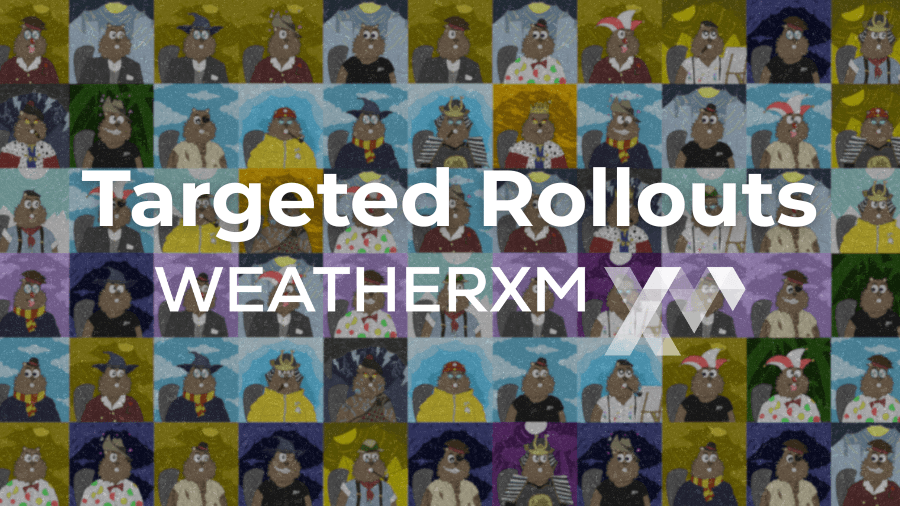
At the center of this rollout system is a curious little token: the Beaver NFT.

Each Beaver represents one-fourth of a physical weather station, meaning four NFTs together fund the full cost of a device and its deployment.
Here’s how it plays out:
- Supporters mint Beaver NFTs on Base, using USDC or WXM.
- The funds go toward installing verified WeatherXM stations in specific rollout zones, think of them as “funding slots” for regions like South Africa, India or Latin America.
- Deployers (the on-ground operators) handle setup and maintenance, ensuring each station meets WeatherXM’s data quality standards.
- Once operational, stations start generating verified weather data… and with that, tokenized rewards.
Rewards from each station are distributed between the two sides of the rollout:
- 75% of emissions to NFT holders (the supporters who funded the station)
- 25% to deployers who keep the hardware running
- WeatherXM DAO boosts and doubles the rewards (Snapshot)
There’s also an optional staking feature, where holders can lock their NFTs for set durations — 3, 6, or 12 months — in exchange for fixed token yields. The DAO itself occasionally boosts rollout rewards 1:1 to encourage rapid regional coverage.
Mechanically, it’s one of the more sophisticated DePIN rollout systems we’ve seen: clean token logic, transparent roles, and direct mapping between funding and infrastructure.
Just don’t confuse it with a profit engine; it’s a participation model. A way to link on-chain support with real-world impact.
Do Targeted Rollouts actually work? Here’s the data.
Unlike many theoretical token experiments, WeatherXM’s rollouts are already out in the world. And the results can speak for themselves!

In Kenya, the company partnered with BLCK IoT to deploy 130 weather stations in just 45 days. The data gathered didn’t sit idle: it was used to improve crop yield forecasting, water management, and flood modeling.
Local reports note yield improvements of up to 18%, water-usage efficiency gains of 22%, and 30% better flood prediction accuracy — tangible outcomes powered by hyperlocal data.
Down south, South Africa saw an even bigger rollout. Partnering with DePIN SA, WeatherXM installed 320 stations in 90 days, integrating directly with utilities, insurers, and municipalities.
These nodes now feed data for outage prediction and disaster response across several urban and rural districts.
Even beyond Africa, new campaigns are forming across India, Latin America, and Europe. Collectively, these rollouts represent the largest decentralized weather deployment to date: thousands of stations live, millions of data points gathered, and counting.
The Bigger Experiment
When you think about it, Targeted Rollouts are not only a feature drop; they’re a test case for how DePIN can evolve.
Traditionally, infrastructure expansion has two options:
- top-down funding (from a company or foundation), or
- bottom-up investment (through token incentives).
WeatherXM’s rollout model sits in between: community-coordinated infrastructure that aligns with verified demand.
The idea isn’t new in spirit — crowdfunding meets real-world assets, that is — but the implementation here is uniquely transparent. Each NFT directly maps to a piece of hardware, every station’s data is verifiable, and every participant can trace their contribution through an on-chain dashboard.
Following the model of a healthy, demand-focused DePIN, WeatherXM has also shared plans to funnel real-world revenue from these rollouts back into community rewards.
Part of this will come through a token buyback program that allocates up to 30% of network revenue toward supporting the ecosystem!
The real insight is structural: decentralization doesn’t always have to mean chaos. With demand-based targeting, DePIN networks can scale smarter. Each new device serves a purpose from day ONE.
This model could influence how future DePINs fund their hardware growth, turning speculative tokenomics into directed network building.
In that sense, WeatherXM isn’t just forecasting weather; it’s forecasting where decentralized infrastructure might head next… 🤔
How to Join a Targeted Rollout
Participation in WeatherXM’s rollout program is open through its official portal. Here’s what it looks like in practice:
- Go to the Targeted Rollouts page on WeatherXM’s website.
- Connect your wallet to the Base network.
- Mint your Beaver NFT using WXM or USDC
- Once your NFTs are minted, you can track the station’s deployment and monitor its data feed via the WeatherXM dashboard. As soon as a station is live and transmitting verified data, daily rewards begin to accrue automatically.
Participants can also opt to stake their NFTs or simply hold them as proof of contribution to the network’s growth.
The Bigger Forecast
DePIN projects are, at their core, experiments in coordination. How do you build shared infrastructure without a central authority? How do you make participation open without turning it into speculation?
WeatherXM’s Targeted Rollouts are one possible answer. By linking data demand, community participation, and transparent deployment, they’re showing what a funded-by-many approach can look like in practice.
Every experiment starts somewhere, and this one moves DePIN closer to a more collaborative, grounded future.
The forecast for decentralized infrastructure? Still partly cloudy, but with growing clarity.
Learn more about WeatherXM’s Targeted Rollouts and how to mint your Beaver NFT here.
